(C)
Whenever we face any challenge,we stop and ask,"What if?" What if we challenge the rules and start thinking outside the box?
Thinking outside the box is a metaphor(隐喻)often used to describe different or creative thinking. It shows up in simple things like using paper to make artworks, instead of just writing on them.
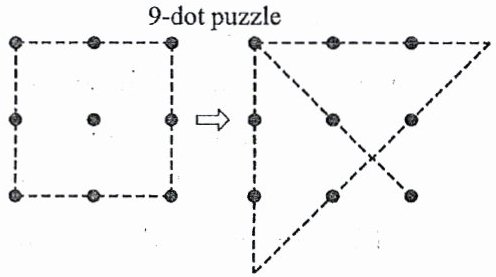
Once a teacher gave the students a 9-dot puzzle(谜)and asked them to connect the dots with only 4 lines. Naturally,this task requires some lateral thinking(跨界思维),so the teacher encouraged the students to "think outside the box". In this case, students needed to look beyond the box and create something else.
One thing stands out for us from this exercise. At first,you see a box. To draw those 4 lines,you have to first use up all the ways within the box. Only then can you realize that the problem is the box itself. You understand the box and discover its limitations. To think outside the box is to fully understand the situation—then challenge it.
Thinking outside the box helps you solve challenging problems. It allows you to look beyond a narrow view to find answers. This way of thinking also pushes you to explore new possibilities. Trying new things,imagining different answers,and daring to make mistakes help people improve.
Thinking small keeps us small. When we stay within our comfort zone(舒适区),taking risks,growing,and challenging all make us feel scared. To become a good leader,or a team member,think outside the box.
Whatever you do,think twice:First in the box,then outside the box. Outside-the-box thinking often breaks the habits and may sound strange at first. But without thinking outside the box,these people, like Thomas Edison,Isaac Newton,wouldn't have changed the world in the way they did. Master the basic rules of your craft, use them properly and if they're not bringing results,allow yourself to start thinking outside the box. You'll be glad you did.
(
)7. Which of the following is an example of the "lateral thinking"?
A. Watching TV in the evening.
B. Buying milk at a supermarket.
C. Taking the bus to the office.
D. Using a plastic bottle as a bird bowl.
(
)8. What does the sentence "Thinking small keeps us small." mean in Paragraph 5?
A. Small thinking helps achieve big success.
B. Avoiding challenges and risks limits personal growth.
C. Big thinking leads to unnecessary risks and problems.
D. Small thinking is the key to staying safe and comfortable.
(
)9. What's the main purpose in writing this passage?
A. To discuss unusual methods.
B. To doubt creative thinking.
C. To explain ways to avoid risks.
D. To encourage us to think creatively.