五、热点素材阅读理解。
At 11:44 p. m., on October 31, 2025, Shenzhour21 was successfully launched from the Jiuquan Satellite Launch Centre. Carried by the Long March 2F Y21 carrier rocket, the spaceship entered its predetermined orbit(预定轨道)about 10 minutes later, with astronauts Zhang Lu, Wu Fei, and Zhang Hongzhang in good condition. This was the 37th flight mission of China's manned space programme(载人航天工程)and the final manned mission of 2025, marking solid progress in China's aerospace cause(航天事业).
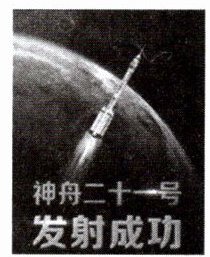
A major highlight was its ultra-fast autonomous rendezvous and docking(自主交会对接). At 3:22 on November 1, only 3. 5 hours after the launch, the spaceship docked with the Tianhe core module(天和核心舱)of China's space station. This set a new record for China's manned space missions, showing the maturity of its docking technology. The scheme balanced efficiency and safety, greatly improving the space station's in-orbit operation efficiency(在轨运行效率).
Soon after, the 7th “space meeting” in China's aerospace history happened. The Shenzhou-21 crew met the Shenzhou-20 crew, who had been on orbit for over 180 days. They conducted a 5-day in-orbit handover(在轨交接), including file and equipment transfer, ensuring the space station's stable operation.
During their stay, the crew completed many scientific projects, including China's first in-orbit rodent mammal experiment(在轨啮齿类哺乳动物实验)to support long-term manned spaceflight(长期载人航天). They also installed space debris protection devices(空间碎片防护装置)and performed extravehicular activities(出舱活动)for equipment maintenance. The rocket had nearly 20 technical improvements, and the return capsule(返回舱)was optimized to enhance load capacity.
As a key mission in the space station's application phase, Shenzhou-21 improved the station's operation capability and accumulated experience for future tasks. It showcases China's growing aerospace strength and inspires people to pursue dreams in science and space exploration.
![
]
(
B
)1. How long did it take Shenzhou-21 to dock with the Tianhe core module after the launch?
A. About 10 minutes.
B. 3. 5 hours.
C. 5 days.
D. Over 180 days.
(
B
)2. What can we infer from the passage about China's aerospace industry?
A. It has no room for further improvement.
B. It is developing rapidly and has strong strength.
C. It only focuses on manned space missions.
D. It has never set any records in space technology.
(
D
)3. Which of the following is NOT part of the Shenzhou-21 crew's in-orbit tasks?
A. Completing many scientific projects including a rodent mammal experiment.
B. Installing space debris protection devices outside the station.
C. Conducting a 5-day in-orbit handover with Shenzhou-20 crew.
D. Making nearly 20 technical improvements with the rocket.
(
A
)4. 新考法 What is the structure of the passage?
A. ①/②③④/⑤
B. ①②/③④/⑤
C. ①/②③/④⑤
D. ①②③/④/⑤
(
B
)5. 新考法 Who is the passage most likely written for?
A. Astronauts preparing for space missions.
B. Middle school students interested in space.
C. Scientists researching rocket technology.
D. Engineers designing space stations.