Ⅲ. 阅读理解(每小题 2.5 分,满分 20 分)
A
① Have you heard of the famous sentence “Using copper(铜)as a mirror, you can straighten your clothes; with history as a mirror, you can know the ups and downs of a country”? Today I'm going to talk about my understanding of learning history.
②Many of you may think it is difficult to study history. A number of students hold a misunderstanding towards history study. However, every subject has its own value, including history.
③History is not just a study of the past from which we can learn a lot whether it's good or bad. History is the study of the people and events that will influence the future.
④In fact, if we study history, we can learn quite a lot about personal stories and events of people just like us. The people who came before us helped build and develop the country we are living in. Studying the past helps to see how their experiences have shaped our own lives.
⑤To be honest, not everything that happened in the past is good. Some of what we study in history helps us understand the mistakes(错误)of the past. And these mistakes will help people not to make the same mistakes. People often learn from the past to have a better future.
⑥Whether we like the subject of history or not, we must understand the importance of the events and the people who came before us. Our ancestors' decisions have influenced our own life. Similarly, the decisions of our own generation(一代人)will finally influence those who come after us. In this only way, the world is truly connected.
⑦So, learning history is necessary and important. We should try our best to learn it well.
1. The writer uses the sentence in the beginning to ______ .
A. express the importance of history
B. show readers the topic(话题)
C. introduce history events
D. interest readers in family memory
2. According to Paragraph 6, which of the following is TRUE?
A. The decisions of our generation will show what is happening to us.
B. The decisions of our generation will build and develop our country.
C. The decisions of our generation will influence the people in the future.
D. The decisions of our generation will help understand the people in the past.
3. What's the writer's purpose(目的)in writing the passage?
A. To introduce some important people in history.
B. To express the importance of learning history.
C. To explain different people's understanding of history.
D. To show the relationship between the past and the future.
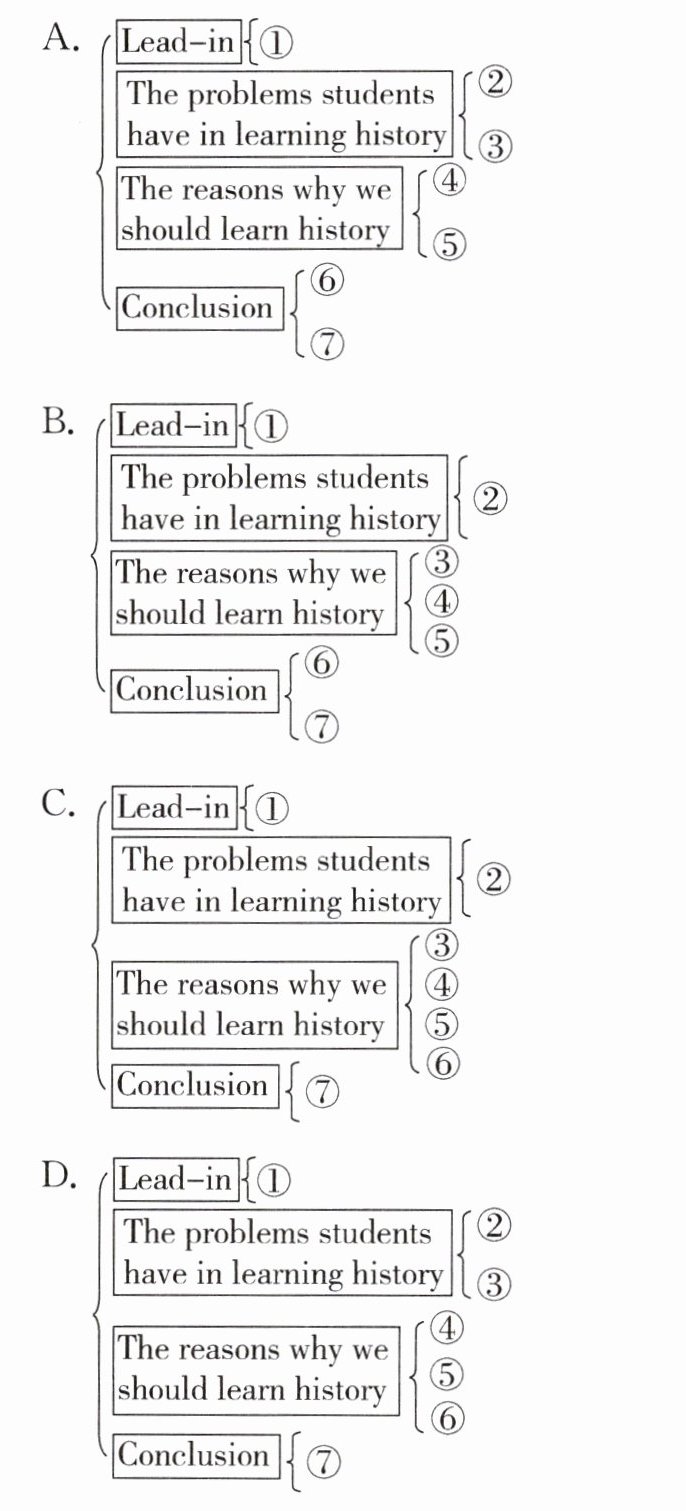
4. What is the structure(结构)of the passage?