(C)
Xie Wanying,also known by her pen name Bing Xin,was a famous Chinese poet born in Fuzhou,Fujian Province in 1900. Though she travelled widely, she often wrote about her hometown and its beautiful women. In her essay The Charms of My Hometown,Bing Xin described the strong and pretty women of Fuzhou,who wore their black hair with three shining silver hairpins, like sharp blades(刃).
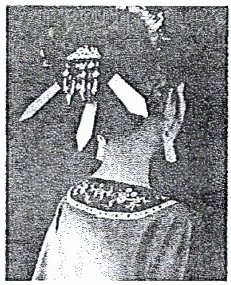
These hairpins,called "tri-hairpins", are made of one vertical(垂直的)pin and two near-horizontal pins, each about 20 centimetres long and weighing 35 to 50 grams. While some were made of gold,most were silver or white bronze, and poorer families used bamboo.
The history of tri-hairpins dates back to the Western Jin dynasty, as mentioned in the Book of Jin. Women wore headdresses shaped like "three weapons", believed to
ward off bad luck. Another story says that during the Ming and Qing Dynasties,Fuzhou women used their hair as knives to guard against pirates(海盗).
In 1917,Zhang Zunxu wrote about Fuzhou women wearing knife-like hairpins,comparing them to ancient Roman armies. However,in 1930,Fang Shengtao,the acting governor of Fujian,banned(禁止)tri-hairpins. Police would take them away from women who wore them in public. Because of this rule,fewer and fewer women wore the traditional hairpins until they were hardly seen.
Recently,tri-hairpins are making a comeback in Fuzhou. Photography studios offer ancient headpieces,and young women wear tri-hairpins for photos in historic settings. The comeback is thanks to hanfu designer Huang Qiuhui and her team,who recreated the hairpins from old photographs. Huang believes the tri-hairpin's spirit of courage and balance is admirable and should be passed down.
The modern tri-hairpin has a brush-like tip and colourful decorations. It shows good luck and meets young people's preferences,which gives the tri-hairpin a new life in the 21st century.
(
D
)7. How does the writer lead into the topic?
A. By asking Bing Xin some questions.
B. By telling a history story about hairpins.
C. By describing a scene with women of Fuzhou.
D. By introducing a famous person and her work.
(
C
)8. What do the underlined words "ward off" probably mean?
A. Welcome.
B. Celebrate.
C. Avoid.
D. Bring.
(
D
)9. What is the purpose of the passage?
A. To ask people to protect tri-hairpins.
B. To explain the meaning of tri-hairpins.
C. To tell the purpose of wearing tri-hairpins.
D. To tell us some information about tri-hairpins.