四、信息还原
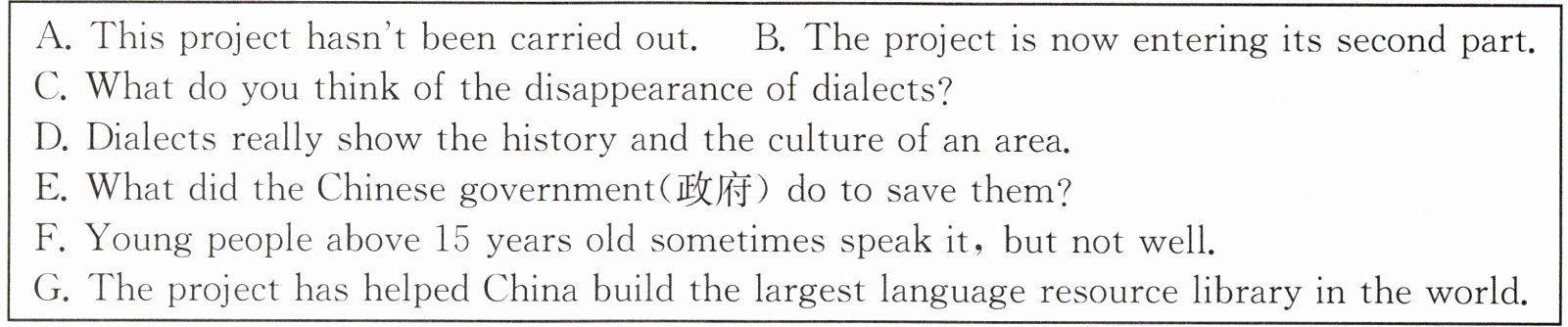
Do you speak a dialect in daily life? While many Chinese speak Putonghua, some local dialects are in danger of disappearing (消失). 1.
E
It started the Chinese Language Resources (资源) Protection Project (工程) a few years ago.
This project looks at how people talk in 1 712 places. Their languages include 103 dialects that are almost gone. 2.
G
In the online library, people can learn dialects.
Why is it important to protect the dialect culture? According to Harold Palmer, an expert (专家) who studies language, dialects are a key to protecting local culture. 3.
D
Scholar (学者) Zhang Hongming talked about these worries of the disappearance of dialects. Now in the Wu dialect areas, some children aged 6 to 15 can understand but can't speak the local dialect. 4.
F
If this keeps happening, the dialect might disappear.
So how did China make this big library? Over five years, more than 350 universities (大学) and research groups joined in, along with over 4 500 experts and more than 6 000 dialect speakers.
5.
B
This includes creating online tools like apps and mobile dictionaries (词典) to help people learn dialects.
解析:
翻译:
### 四、信息还原
你在日常生活中说方言吗?虽然很多中国人说普通话,但一些地方方言正面临消失的危险。1. 几年前,它启动了中国语言资源保护工程。
这个项目研究了1712个地方的人们的说话方式。他们的语言包括103种几乎消失的方言。2. 在这个在线图书馆里,人们可以学习方言。
为什么保护方言文化很重要?研究语言的专家哈罗德·帕尔默认为,方言是保护地方文化的关键。3.
学者张洪明谈到了方言消失的这些担忧。现在在吴语地区,一些6到15岁的孩子能听懂但不会说当地方言。4. 如果这种情况持续下去,方言可能会消失。
那么中国是如何建立这个大图书馆的呢?在五年多的时间里,350多所大学和研究团体参与其中,还有4500多名专家和6000多名方言使用者。
5. 这包括创建像应用程序和移动词典这样的在线工具来帮助人们学习方言。