Ⅳ.阅读理解
A
Hello, my name is David. I study in No. 5 Middle School. I’m in Class 2, Grade 7. Here is a survey (调查) about my classmates’ favorite subjects and activities(活动).
Next month, we will have an art festival. Welcome to our art festival! It will be very interesting.
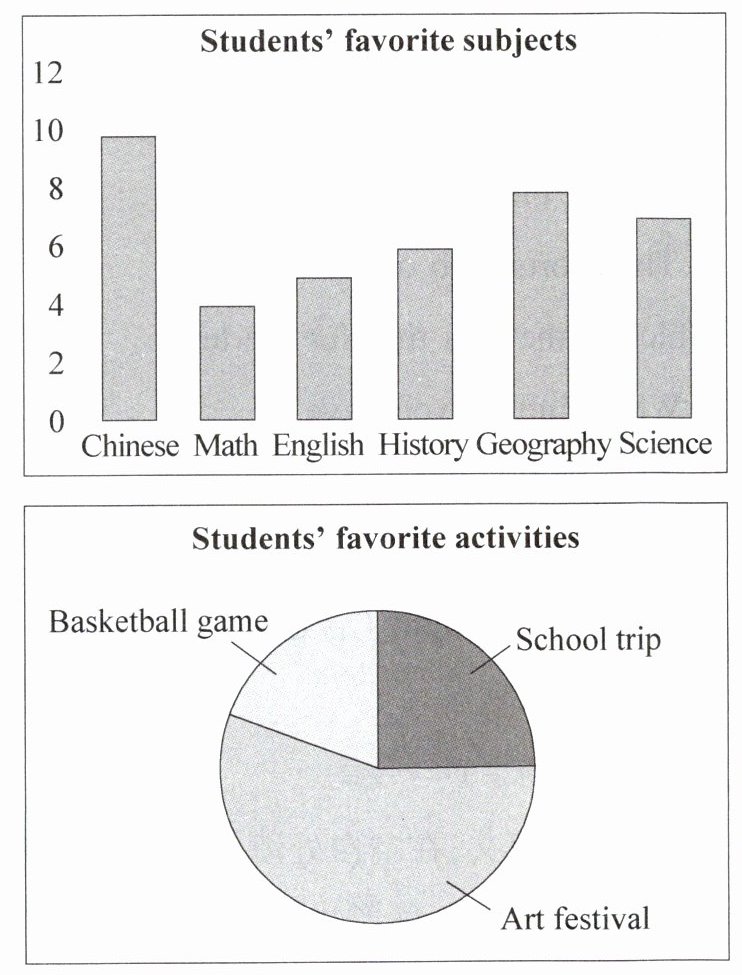
19. There are
students in David’s class.
A. 39 B. 40 C. 41 D. 42
20. Students in his class like
best.
A. Chinese B. math
C. English D. science
21. How many students like geography best?
A. 4. B. 8. C. 10. D. 12.
22. Most of(大多数)the students’ favorite activity is
.
A. the basketball game
B. the school trip
C. the art festival
D. a book sale
23. When do they have an art festival?
A. Next day. B. Next week.
C. Next month. D. Next term.
答案:Ⅳ. A
[语篇解读] 短文是一个关于戴维的同班同学最喜欢的科目和活动的调查结果。
19.B 图表理解题。根据第一个统计图可知,戴维的班级有(10+4+5+6+8+7)40人。故选B。
20.A 图表理解题。根据第一个统计图中柱状图的高度可知,喜欢语文的人最多。故选A。
21.B 图表理解题。根据“Geography”对应的柱状图所对应的数字可知,最喜欢地理的有8人。故选B。
22.C 图表理解题。根据饼状图中各项活动对应的面积可知,大多数人喜欢艺术节。故选C。
23.C 细节理解题。根据“Next month,we will have an art festival.”可知,下个月有艺术节。故选C。
解析:
翻译:
### Ⅳ. 阅读理解
#### A
大家好,我叫大卫。我在第五中学学习。我在七年级二班。这里有一份关于我同学们最喜欢的学科和活动的调查。
下个月,我们将举办一场艺术节。欢迎来参加我们的艺术节!它将会非常有趣。
19. 大卫的班里有______名学生。
A. 39 B. 40 C. 41 D. 42
20. 他班里的学生最喜欢______。
A. 语文 B. 数学
C. 英语 D. 科学
21. 有多少名学生最喜欢地理?
A. 4。 B. 8。 C. 10。 D. 12。
22. 大多数学生最喜欢的活动是______。
A. 篮球比赛
B. 学校旅行
C. 艺术节
D. 图书售卖活动
23. 他们什么时候举办艺术节?
A. 明天。 B. 下周。
C. 下个月。 D. 下学期。
B
In China, there are 24 solar terms in a year. And there are six solar terms in winter. They are the Beginning of Winter(立冬), Light Snow(小雪), Heavy Snow(大雪), the Winter Solstice (冬至), Lesser Cold (小寒) and Greater Cold (大寒).
The Beginning of Winter usually falls on November 7th or 8th. On this day, after a year of hard work, people are happy to have a rest and spend time with the family. In the north of China, people usually have dumplings and mutton soup on that day.
Light Snow usually falls on November 22nd or 23rd and Heavy Snow usually falls on December 7th or 8th. When the Winter Solstice comes, it brings the shortest day and the longest night of the year. Many places around the country can expect the coldest weather.
Greater Cold comes after Lesser Cold. The field is covered with snow. And all Chinese are ready to welcome the Spring Festival after it. Of course, a new round of solar terms will start.
24. How many solar terms are there in winter?
A. Five. B. Six.
C. Seven. D. Twenty - four.
25. What do people in the north of China usually have on the day of the Beginning of Winter?
A. Dumplings and mutton soup.
B. Noodles and fish soup.
C. Rice and chicken soup.
D. Dumplings and beef soup.
26. When does Heavy Snow usually fall?
A. On November 22nd or 23rd.
B. On December 1st or 2nd.
C. On December 7th or 8th.
D. On November 7th or 8th.
27. What is the passage mainly about?
A. The Beginning of Winter.
B. The solar terms in winter.
C. Heavy Cold.
D. The 24 solar terms.
28. Where can you find this passage?
A. A novel. B. A science magazine.
C. A storybook. D. A cartoon book.
答案:B
[语篇解读] 本文主要介绍了冬季的六个节气。
24.B 细节理解题。根据第一段中的“there are six solar terms in winter”可知,冬季有六个节气,故选B。
25.A 细节理解题。根据第二段中的“In the north of China,people usually have dumplings and mutton soup on that day.”可知,北方人立冬时通常吃饺子、喝羊肉汤,故选A。
26.C 细节理解题。根据第三段中的“Heavy Snow usually falls on December 7th or 8th”可知,大雪节气通常在12月7日或8日,故选C。
27.B 主旨大意题。通读全文可知,本文主要介绍了冬季的六个节气,故选B。
28.B 文章出处题。本文主要讲了冬季的六个节气,合适的出处是“科学杂志”,故选B。
解析:
翻译:
### B
在中国,一年有24个节气。冬季有6个节气,分别是立冬、小雪、大雪、冬至、小寒和大寒。
立冬通常在11月7日或8日。在这一天,经过一年的辛勤劳作,人们乐于休息并与家人共度时光。在中国北方,人们在立冬这一天通常会吃饺子和喝羊肉汤。
小雪通常在11月22日或23日,大雪通常在12月7日或8日。当冬至来临时,它带来一年中白昼最短、夜晚最长的一天。全国许多地方会迎来最冷的天气。
大寒在小寒之后。田野被雪覆盖。大寒之后,所有中国人都准备好迎接春节了。当然,新一轮的节气又将开始。
24. 冬季有多少个节气?
A. 5个。
B. 6个。
C. 7个。
D. 24个。
25. 中国北方的人们在立冬那天通常吃什么?
A. 饺子和羊肉汤。
B. 面条和鱼汤。
C. 米饭和鸡汤。
D. 饺子和牛肉汤。
26. 大雪通常在什么时候到来?
A. 11月22日或23日。
B. 12月1日或2日。
C. 12月7日或8日。
D. 11月7日或8日。
27. 这篇文章主要讲的是什么?
A. 立冬。
B. 冬季的节气。
C. 大寒。
D. 24个节气。
28. 你可以在哪里找到这篇文章?
A. 一本小说。
B. 一本科学杂志。
C. 一本故事书。
D. 一本漫画书。